World Economy Gdp

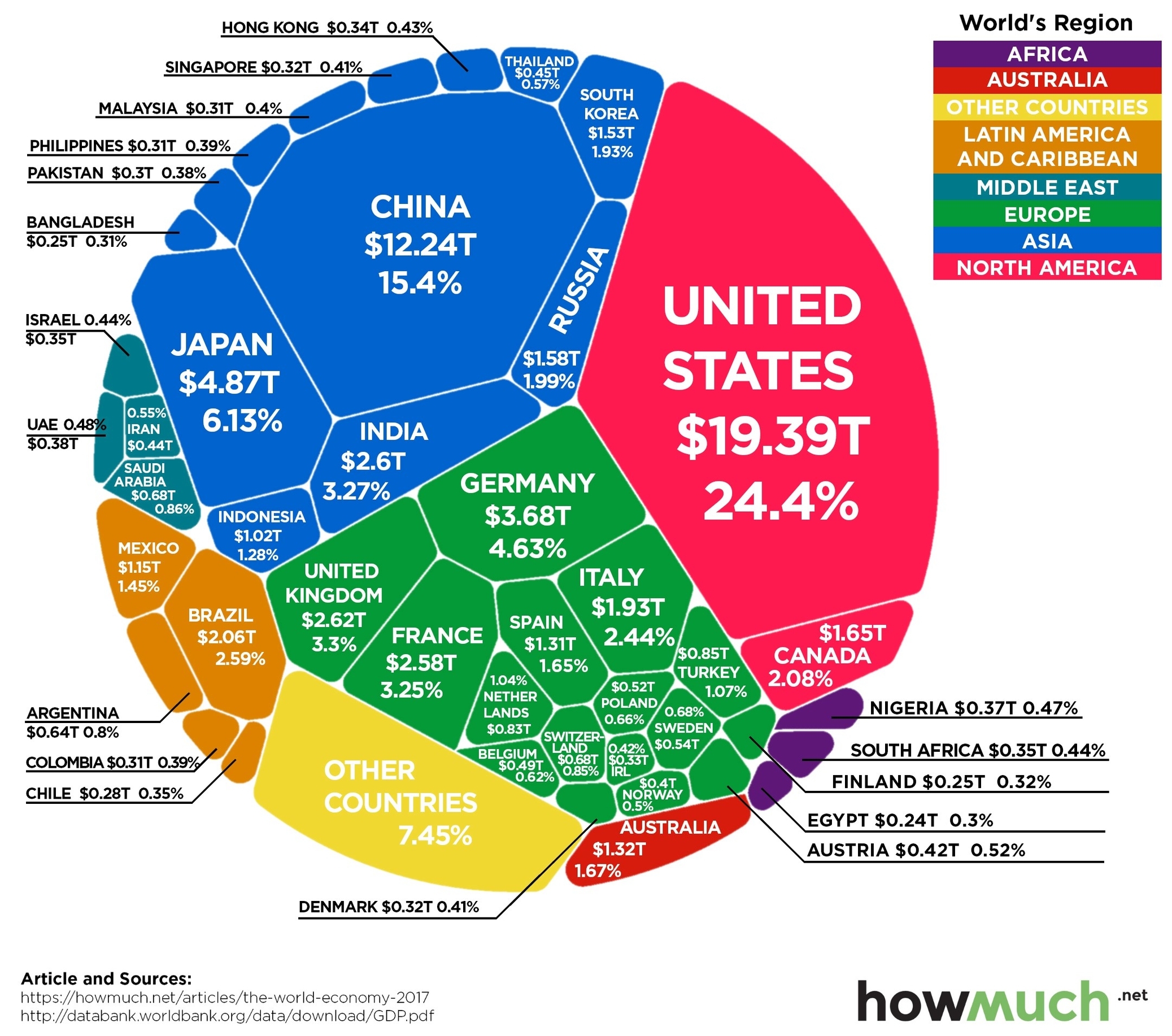
The Gross Domestic Product (GDP) is a measure of the economic performance of a country. It is the total value of all goods and services produced within a country in a given year. The GDP is an important indicator of the economic health of a country and is used to compare the economic performance of different countries. According to the International Monetary Fund (IMF), the world’s nominal GDP in 2022 was $100,562,000,000,000 .

The nominal GDP of a country is calculated using the market or government official exchange rates. However, nominal GDP does not take into account differences in the cost of living in different countries, and the results can vary greatly from one year to another based on fluctuations in the exchange rates of the country’s currency . Therefore, comparisons of national wealth are also frequently made on the basis of purchasing power parity (PPP), which adjusts for differences in the cost of living in different countries .

The United States has the highest nominal GDP in the world, with a nominal GDP of $25,462,700,000,000 in 2022 . China is the second-largest economy in the world, with a nominal GDP of $17,963,200,000,000 in 2022 . Japan is the third-largest economy in the world, with a nominal GDP of $4,231,140,000,000 in 2022 .

The nominal GDP per capita is another important measure of the economic performance of a country. It is calculated by dividing the nominal GDP of a country by its population. The nominal GDP per capita of the United States is $75,269 in 2022, while that of China is $12,598 in 2022 .

The GDP of a country is influenced by various factors such as the size of the population, natural resources, infrastructure, political stability, and economic policies. The GDP growth rate is an important indicator of the economic health of a country. The global economy is showing signs of improvement, but the recovery will be weak, according to the Organisation for Economic Co-operation and Development (OECD). Its latest Economic Outlook predicts global GDP will grow 2.7% in 2023, with a modest improvement of 2.9% in 2024 .

In conclusion, the GDP is an important measure of the economic performance of a country. The nominal GDP of a country is calculated using the market or government official exchange rates, while the nominal GDP per capita is calculated by dividing the nominal GDP of a country by its population. The GDP of a country is influenced by various factors such as the size of the population, natural resources, infrastructure, political stability, and economic policies. The global economy is showing signs of improvement, but the recovery will be weak, according to the OECD .
World Economy Gdp

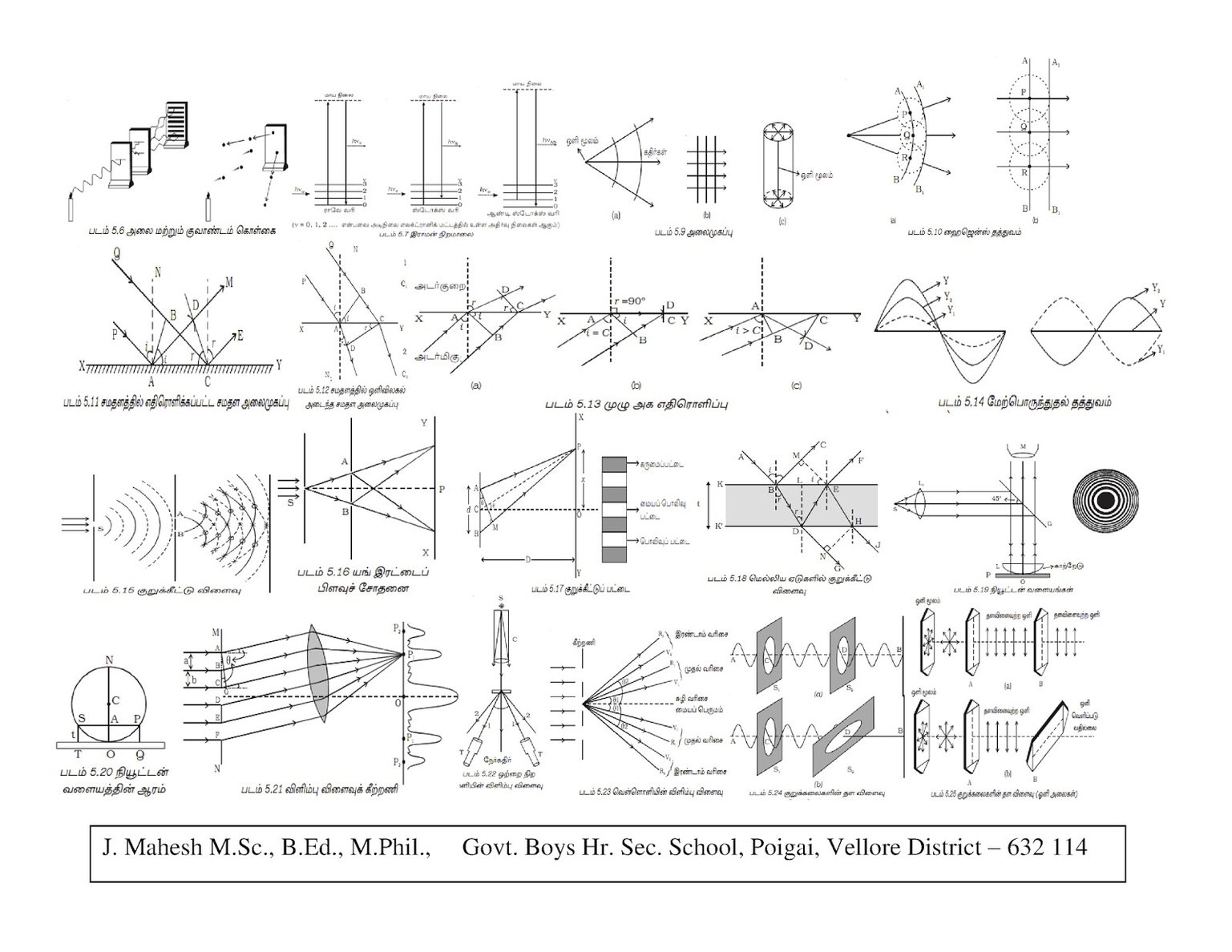
Physics Diagram Only

Physics is a branch of science that deals with the study of matter, energy, and their interactions. It is a fundamental science that seeks to explain the natural phenomena that occur in the universe. The study of physics has led to many technological advancements that have transformed the world we live in today.

The field of physics is vast and encompasses many subfields. Some of the major subfields of physics include mechanics, thermodynamics, electromagnetism, optics, and quantum mechanics. Mechanics is the study of motion and the forces that cause motion. Thermodynamics is the study of heat and temperature and their relationship to energy. Electromagnetism is the study of electric and magnetic fields and their interactions. Optics is the study of light and its properties. Quantum mechanics is the study of the behavior of matter and energy at the atomic and subatomic level.

The study of physics is important because it helps us understand the world around us. It provides us with a framework for understanding the laws of nature and how they govern the behavior of matter and energy. Physics has led to many technological advancements that have transformed the world we live in today. For example, the development of the transistor, which is a key component of modern electronics, was made possible by the discovery of quantum mechanics. The study of physics has also led to the development of technologies such as lasers, nuclear power, and medical imaging.

In summary, physics is a fundamental science that seeks to explain the natural phenomena that occur in the universe. It is a vast field that encompasses many subfields, including mechanics, thermodynamics, electromagnetism, optics, and quantum mechanics. The study of physics is important because it helps us understand the world around us and has led to many technological advancements that have transformed the world we live in today.

Physics Diagram Only

Quantum Physics Drawing

Quantum Physics 98 is not a well-defined term, but it could be interpreted as a course or a topic related to quantum physics, the branch of physics that deals with the behavior of matter and energy at the smallest scales. Quantum physics is based on the idea that physical quantities, such as the position, momentum, energy, and spin of a particle, can only take discrete values, called quanta. Quantum physics also introduces the concept of wave-particle duality, which states that all particles can behave like waves and vice versa, depending on how they are observed. Furthermore, quantum physics reveals the phenomenon of quantum entanglement, which means that two or more particles can share a quantum state and influence each other, even when they are separated by large distances.

Quantum physics is one of the most fascinating and challenging fields of science, as it often defies our common sense and intuition. It also has many applications and implications for technology, information, security, mathematics, and philosophy. Some of the topics that quantum physics covers are:

– The experimental basis of quantum physics, such as the photoelectric effect, the Compton effect, the double-slit experiment, the Stern-Gerlach experiment, and the EPR paradox.
– The mathematical formalism of quantum mechanics, such as the Schrödinger equation, the Heisenberg uncertainty principle, the Dirac notation, the Hilbert space, the operators, the eigenvalues, and the eigenvectors.
– The single and multiple quantum states, such as the qubit, the superposition, the measurement, the collapse, the basis, the entanglement, and the Bell inequalities.
– The quantum operations, such as the unitary transformations, the quantum gates, the quantum circuits, and the quantum algorithms.
– The quantum systems, such as the harmonic oscillator, the hydrogen atom, the spin, the angular momentum, the tunneling, the scattering, and the resonance.
– The quantum technologies, such as the quantum cryptography, the quantum communication, the quantum metrology, the quantum sensing, the quantum simulation, and the quantum computing.

This is a brief overview of quantum physics, but there is much more to learn and explore. If you are interested in taking a course on quantum physics, you can check out some of the online resources available, such as:

– [Quantum Physics I](^2^), a course from MIT OpenCourseWare that introduces the basic features of quantum mechanics and covers the experimental basis of quantum physics, the wave mechanics, and the Schrödinger equation in one and three dimensions.
– [Quantum Physics](^3^), a course from Khan Academy that covers the basics of quantum physics, such as the photoelectric effect, the Bohr model, the de Broglie wavelength, the Heisenberg uncertainty principle, and the quantum numbers.
– [The Mathematics of Quantum Mechanics](^1^), a book from the University of Waterloo that explains the mathematical concepts and tools needed to understand quantum mechanics, such as the complex numbers, the linear algebra, the inner product, the observables, and the postulates.

Quantum Physics Drawing

Bar Diagrams For Problem Solving

The Bar Model is a mathematical diagram that is used to represent and solve problems involving quantities and their relationships to one another. It was developed in Singapore in the 1980s when data showed Singapore’s elementary school students were lagging behind their peers in math. An analysis of testing data at the time showed less than half of Singapore’s students in grades 2-4 could solve word problems that were presented without keywords such as “altogether” or “left.” Something had to be done, and that something was the introduction of the bar model, which has been widely credited with rocketing the kids of Singapore to the top of math scores for kids all around the globe .

The Bar Model is an explicit teaching and learning strategy for problem-solving. The actual bar model consists of a set of bars or rectangles that represent the quantities in the problem, and the operations are represented by the lengths and arrangements of the bars. Among its strengths is the fact that it can be applied to all operations, including multiplication and division. They’re also useful when it comes to teaching students more advanced math concepts, such as ratios and proportionality. The Bar Model combines the concrete (drawings) and the abstract (algorithms or equations) to help the student solve the problem .

The Bar Model is a powerful tool for visualizing and solving mathematical problems. It is especially useful for students who struggle with abstract concepts and need a more concrete way to understand mathematical relationships. The Bar Model can be used to solve a wide range of problems, from simple addition and subtraction to more complex algebraic equations. The Bar Model is also a great way to introduce students to the concept of algebra, as it provides a visual representation of the relationships between variables .

The Bar Model is a versatile tool that can be used in a variety of ways to help students learn math. For example, it can be used to help students understand fractions and decimals, as well as to solve problems involving percentages. The Bar Model can also be used to help students understand geometry, as it provides a visual representation of geometric shapes and their properties. In addition, the Bar Model can be used to help students understand data analysis and statistics, as it provides a way to visualize data and relationships between variables .

In conclusion, the Bar Model is a powerful tool for teaching and learning mathematics. It provides a concrete way for students to visualize and solve mathematical problems, and it can be used to teach a wide range of mathematical concepts. The Bar Model is especially useful for students who struggle with abstract concepts and need a more concrete way to understand mathematical relationships. By using the Bar Model, teachers can help their students develop a deeper understanding of mathematics and improve their problem-solving skills .

Bar Diagrams For Problem Solving

Physics Symbols And Names

Physics is a fascinating field of study that deals with the fundamental principles of the universe. It is a science that uses mathematical models to explain the behavior of matter and energy. Symbols are an essential part of physics, as they help us to represent physical quantities and make calculations more convenient. Here are some of the most commonly used physics symbols and their names:

– a: Acceleration
– A: Area
– B: Magnetic field
– C: Capacitance
– c: Speed of light
– d: Distance
– E: Electric field
– F: Force
– f: Frequency
– G: Gravitational constant
– h: Planck’s constant
– I: Current
– k: Boltzmann constant
– L: Inductance
– m: Mass
– n: Number density
– P: Power
– p: Momentum
– Q: Charge
– r: Radius
– R: Resistance
– T: Temperature
– t: Time
– U: Potential energy
– V: Voltage
– v: Velocity
– W: Work
– x: Displacement
– y: Height
– z: Depth

These symbols are used to represent physical quantities such as distance, time, mass, velocity, acceleration, force, energy, and power, among others. They are often combined with other symbols to represent more complex physical quantities. For example, the symbol F (force) can be combined with the symbol d (distance) to represent work, which is the product of force and distance.

It is important to note that the symbols used in physics are not arbitrary but are based on a set of conventions. For example, the symbol c is used to represent the speed of light because it is the first letter of the Latin word “celeritas,” which means speed. Similarly, the symbol h is used to represent Planck’s constant because it is the first letter of the German word “hinzpeter,” which means constant.

In conclusion, physics symbols are an essential part of the language of physics. They help us to represent physical quantities and make calculations more convenient. The symbols used in physics are not arbitrary but are based on a set of conventions.

Physics Symbols And Names

Economic Chart 9

Economic 9 is a course that is typically taught to students in the ninth grade. It is an introductory course that covers the basics of economics, including topics such as supply and demand, market structures, and international trade. The course is designed to provide students with a solid foundation in economics, which they can build upon in future courses.

One of the key concepts covered in Economic 9 is supply and demand. This concept is fundamental to understanding how markets work. In a market economy, prices are determined by the interaction of supply and demand. When the supply of a good or service is high and the demand is low, the price will be low. Conversely, when the supply is low and the demand is high, the price will be high. Understanding this relationship is essential for anyone who wants to understand how markets work.

Another important topic covered in Economic 9 is market structures. There are four main types of market structures: perfect competition, monopolistic competition, oligopoly, and monopoly. Each of these market structures has its own unique characteristics, and understanding them is important for understanding how different industries operate.

International trade is another important topic covered in Economic 9. In today’s globalized world, international trade is a critical component of many economies. Students in Economic 9 learn about the benefits and drawbacks of international trade, as well as the different types of trade barriers that exist.

In addition to these topics, Economic 9 also covers a range of other concepts, including inflation, unemployment, and economic growth. By the end of the course, students should have a solid understanding of the basics of economics, which will serve them well in future courses and in their personal lives.

Economic Chart 9

Organic Farming And Carbon Sequestration

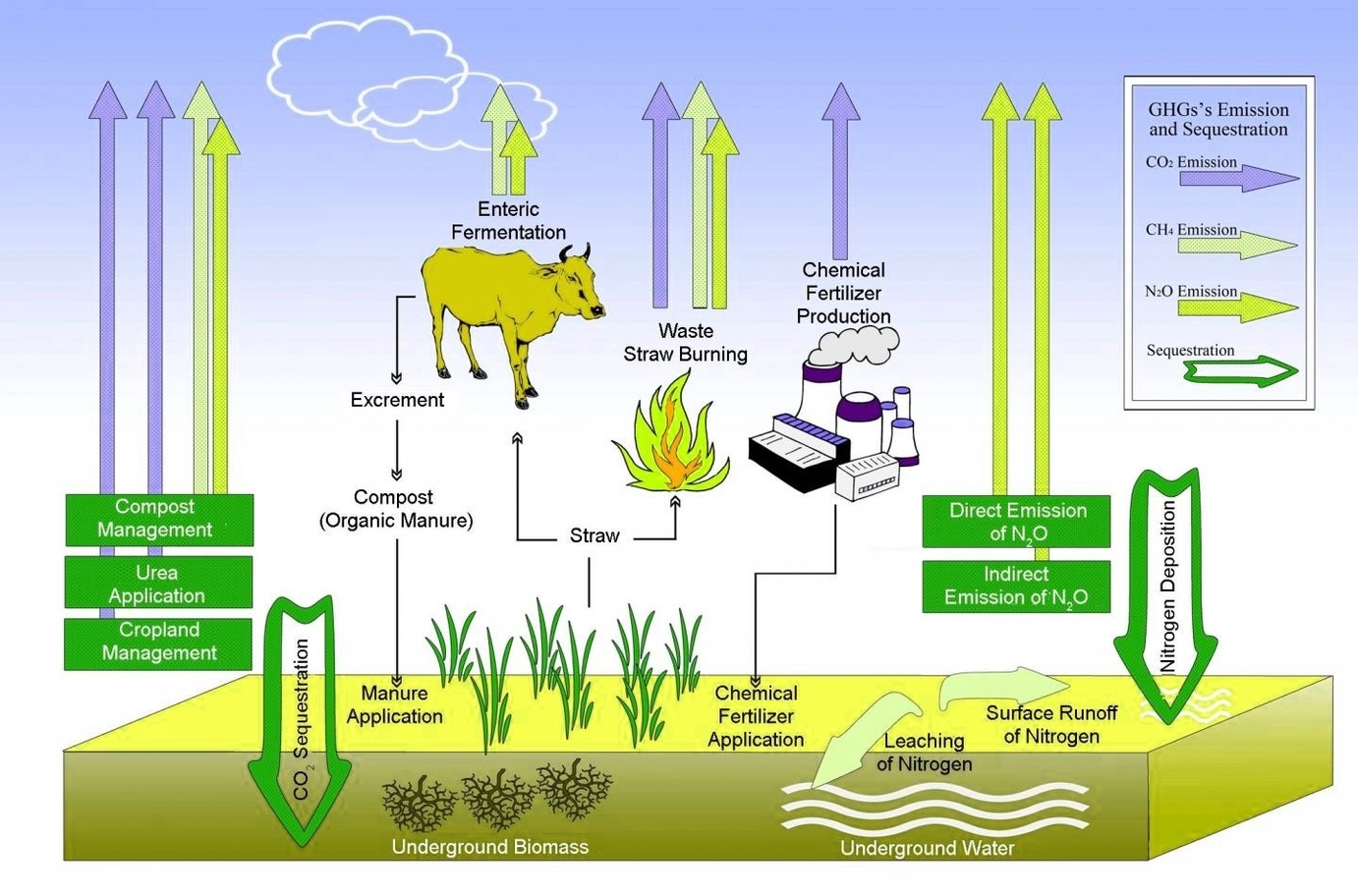
Organic farming is a method of agriculture that avoids the use of synthetic fertilizers, pesticides, and genetically modified organisms (GMOs) in favor of natural and sustainable farming practices. Carbon sequestration is the process of capturing carbon dioxide from the atmosphere and storing it in the soil, trees, and other organic matter. Organic farming can play a significant role in carbon sequestration by promoting healthy soil and plant growth, which can help to reduce greenhouse gas emissions and mitigate climate change.

According to the Rodale Institute, organic farming can help to sequester carbon in the soil by promoting the growth of healthy plants and microorganisms that can capture and store carbon dioxide from the atmosphere . During photosynthesis, plants use solar energy to extract carbohydrate molecules, or sugar, from carbon dioxide. Those carbon-based sugars are extruded from the plant’s roots, feeding bacteria and fungi in the nearby soil. In turn, these microorganisms symbiotically transform soil minerals into nutrients that feed plants and help plants fight disease and pest pressure. During this exchange, the sugars that get consumed by soil bacteria and fungi are converted into more stable materials that trap carbon in the soil for decades, even centuries . The Soil Association estimates that widespread organic farming could potentially sequester 1.5 billion tC per year, which would offset about 11% of all anthropogenic global GHG emissions for at least the next 20 years .

Organic farming practices such as crop rotation, cover cropping, and reduced tillage can help to promote healthy soil and plant growth, which can in turn help to sequester carbon in the soil . By avoiding the use of synthetic fertilizers and pesticides, organic farming can also help to reduce greenhouse gas emissions and mitigate climate change . A 2012 study in the Proceedings of the National Academy of Sciences found increased carbon sequestration in organic farm soils . However, a 2013 letter in the PNAS disputed those findings, arguing that there were no carbon sequestration benefits related to organic farming .

In conclusion, organic farming can play an important role in carbon sequestration by promoting healthy soil and plant growth, which can help to reduce greenhouse gas emissions and mitigate climate change. While there is some debate over the effectiveness of organic farming

Organic Farming And Carbon Sequestration

Force Vector Diagram

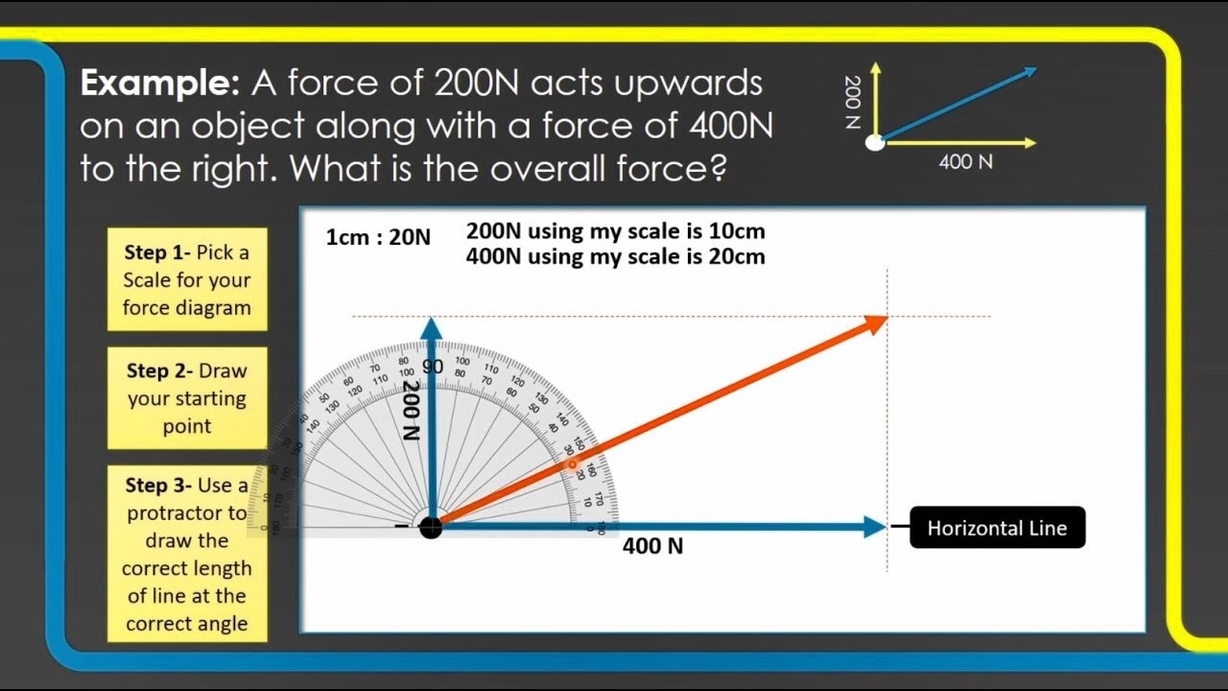
Force is a fundamental concept in physics that describes the influence that can cause an object to change its velocity, i.e., to accelerate, meaning a change in speed or direction, unless counterbalanced by other forces . The concept of force makes the everyday notion of pushing or pulling mathematically precise. Because the magnitude and direction of a force are both important, force is a vector quantity .

A vector quantity is a quantity that has both magnitude and direction. The SI unit of force is the newton (N), and force is often represented by the symbol F . The magnitude of a force is measured in newtons, and its direction is described using a coordinate system .

Forces can be due to phenomena such as gravity, magnetism, or anything that might cause a mass to accelerate . Types of forces often encountered in classical mechanics include elastic, frictional, contact or “normal” forces, and gravitational . The rotational version of force is torque, which produces changes in the rotational speed of an object .

In an extended body, each part often applies forces on the adjacent parts; the distribution of such forces through the body is the internal mechanical stress . The internal mechanical stress is a tensor field that describes the distribution of forces and torques within a body .

In summary, force is a vector quantity that describes the influence that can cause an object to change its velocity, i.e., to accelerate, meaning a change in speed or direction, unless counterbalanced by other forces. The magnitude of a force is measured in newtons, and its direction is described using a coordinate system. Forces can be due to phenomena such as gravity, magnetism, or anything that might cause a mass to accelerate. The internal mechanical stress is a tensor field that describes the distribution of forces and torques within a body.

Force Vector Diagram

How Is A Waterfall Formed

Waterfalls are natural wonders that are formed by the erosion of bedrock and the hydraulic forces of water. The process of erosion is slow and depends on the shape of the waterfall, such as a horseshoe or a cascade. The process of potholing occurs when the waterfall creates a deep hole in the bedrock. Waterfalls form mostly in rivers while they are still young. Their channels are more narrow and deeper, which is the perfect setting for the formation of a waterfall. Waterfalls often start off as rapids, flowing over the hard rocks in the river bottom, while eroding the softer rocks. Due to them eroding slowly, the hard rocks get lifted above the stream bed. However, the speed of the erosion process is highly dependent on the strength of the river.

According to WorldAtlas, waterfalls typically form in young rivers because their channels are narrower and deeper than in established rivers. If the waterfall is shaped like a horseshoe, its erosion is focused on a specific point. The process of formation starts when the river flows through an area that is mostly made up of bedrock. This process is slow but is dominated by the impacts of water on the rocks. Downstream the process is more rapid and severe. The water’s velocity increases the further downstream we go, and it is the highest at the edge of the waterfall. Once the water is there, it may pull out materials from the riverbed. At the bottom of the waterfall, the hydraulic forces are so strong that they are able to reach heights that allow them to erode the riverbed. The process of potholing occurs when turbulent whirlpools start to spin stones around the riverbed and create a deep hole in the bedrock due to erosion. This means that the sand and rocks that get carried by the river increase the capacity of the erosion .

National Geographic Society explains that often, waterfalls form as streams flow from soft rock to hard rock. This happens both laterally (as a stream flows across the earth) and vertically (as the stream drops in a waterfall). In both cases, the soft rock erodes, leaving a hard ledge over which the stream falls. The wearing away of earth plays an important part in the formation of waterfalls. The types, classification, and features of different waterfalls around the world are also discussed .

In summary, waterfalls are formed when a river or stream flows over a ledge or cliff, creating a stunning natural spectacle. The force of the water falling creates a hole in the rock behind it, called a “plunge pool,” and over time, the force of the water falling can erode the rock, creating a deep, narrow channel ..

How Is A Waterfall Formed

Demographic Diagram 6

Demonic is a film that explores the concept of entering the mind of a comatose person through a simulation. The protagonist, Carly, is a young woman who has a strained relationship with her mother, Angela, who is convicted of killing more than 20 people in a rampage. Carly is contacted by a company called Therapol, which claims to have a way of communicating with Angela through a virtual reality device. Carly agrees to participate in the experiment, hoping to find out why her mother became a murderer.

However, Carly soon discovers that there is more to the simulation than meets the eye. She encounters a demonic entity that haunts Angela’s mind and tries to possess Carly as well. Carly also learns that Therapol is not a benevolent organization, but a front for a secret cult that wants to use Angela as a vessel for the demon. Carly teams up with her childhood friend Martin, who has been investigating Therapol and the cult, to stop them from unleashing the demon into the real world.

Demonic is a film that mixes elements of science fiction, horror, and thriller genres. It is the first feature film by Neill Blomkamp since 2015’s Chappie, and was filmed secretly in Canada during the COVID-19 pandemic. The film uses a combination of digital and practical effects, as well as a new volumetric capture technology that creates a realistic 3D representation of the actors. The film received mostly negative reviews from critics, who criticized its story, characters, and scares. The film was released on August 20, 2021, in theaters and on video on demand.
ome possible additional sentences to conclude the response are:

Demographic Diagram 6