Dealing with a preteen

Dealing with a 10-year-old who’s suddenly rude and resisting homework can feel exhausting — especially at that “almost a teenager” stage. At 10, kids are starting to crave independence but still don’t have strong emotional control. That mix often comes out as attitude.

Here’s a practical, calm approach that works better than power struggles:

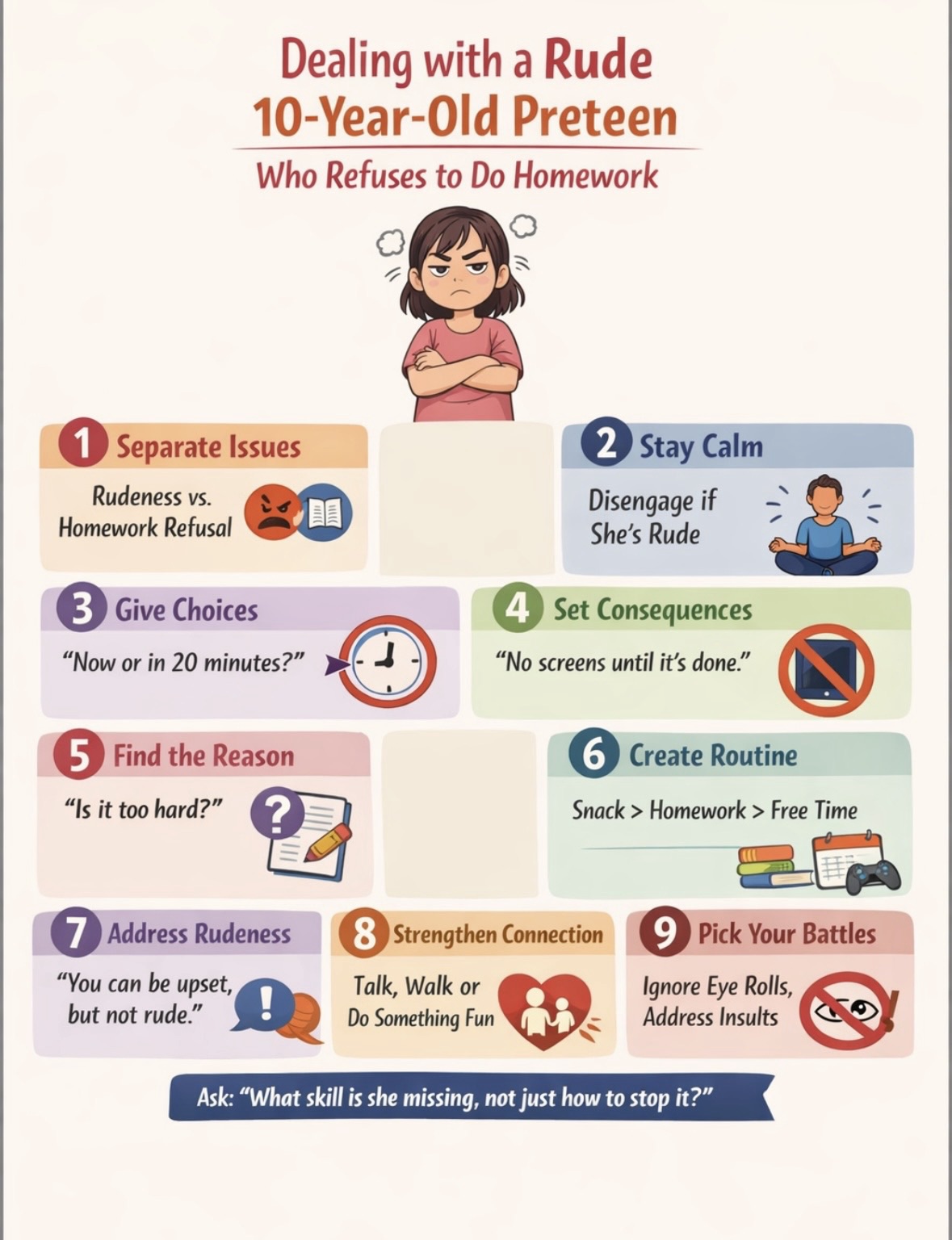
1. Separate the rudeness from the homework issue

Handle them differently.
• Rudeness = behavior problem
• Homework refusal = responsibility/structure problem

If you mix them, it turns into one big emotional fight.

2. Stay calm (even if she isn’t)

If she says:

“I’m not doing it! Stop bothering me!”

Instead of:

“Don’t talk to me like that!”

Try:

“I’m happy to talk, but not when I’m being spoken to like that. Let’s reset.”

Then disengage briefly.

When parents escalate, kids escalate more. Calm wins long-term.

3. Give controlled choices (this age needs autonomy)

Instead of:

“Go do your homework now.”

Try:

“Do you want to start homework now or in 20 minutes?”

Or:

“Math first or reading first?”

She still does it — but she feels some control.

4. Use clear, predictable consequences (no lectures)

If homework isn’t done:
• No screens
• No playdates
• No favorite activity

Say it neutrally:

“Homework needs to be done before screens. That’s the rule.”

Don’t argue about fairness. Calm repetition works better than debating.

5. Watch for the real reason

At 10, resistance is often:
• Homework feels overwhelming
• She doesn’t understand the material
• She’s tired
• She wants attention
• She’s testing boundaries

Ask gently later (not in the middle of conflict):

“Is the homework hard, boring, or something else?”

You might learn something important.

6. Create structure

Kids this age still need routine.

Example:
• Snack
• 20 min break
• Homework time (same time daily)
• Then free time

When it’s predictable, there’s less arguing.

7. Address rudeness directly — but briefly

Later (when calm), say:

“I won’t allow disrespect. You can be upset. You can be frustrated. But you can’t be rude.”

Keep it short. No 20-minute speeches.

8. Strengthen connection

Sometimes rudeness increases when connection decreases.

Even 10–15 minutes of:
• Just talking
• Going for a short walk
• Doing something she likes

can dramatically reduce attitude.

9. Pick your battles

If she rolls her eyes? Ignore it.
If she insults you? Address it.

Not every attitude needs correction.

⚠️ When to look deeper

If you notice:
• Big mood swings
• Sudden drop in grades
• Anxiety about school
• Social problems

There may be more going on than just “preteen attitude.”

One powerful mindset shift

Instead of asking:

“How do I stop this behavior?”

Ask:

“What skill is she missing right now?”

Often it’s:
• Emotional regulation
• Organization
• Frustration tolerance
• Time management

Those need teaching — not punishing.

how to deal with preteen.jpg

Eriksons Stages Of Development

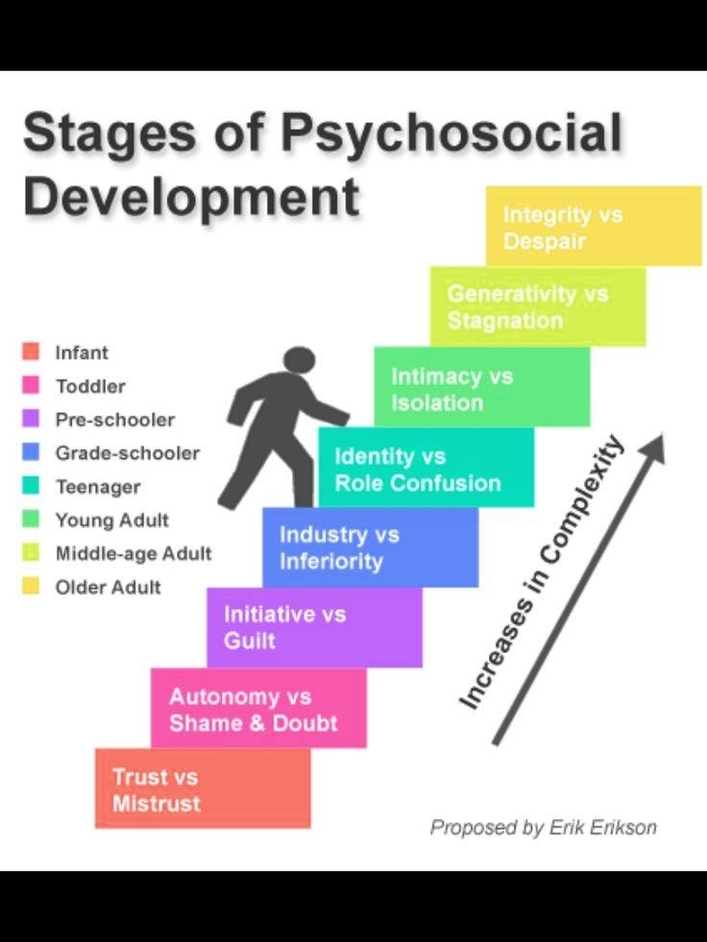
Eriksons Stages Of Development: Erik Erikson proposed eight stages of psychosocial development, each marked by a central conflict that individuals must resolve to move successfully to the next stage. Starting with Trust vs. Mistrust in infancy and ending with Integrity vs. Despair in old age, each stage builds on the outcomes of previous ones. A diagram labels the stages with age ranges and key questions, such as “Can I trust the world?” or “Who am I?”. This model helps explain how personality and identity evolve through life’s challenges.

Erikson's Stages Of Development

Different types of windows chart

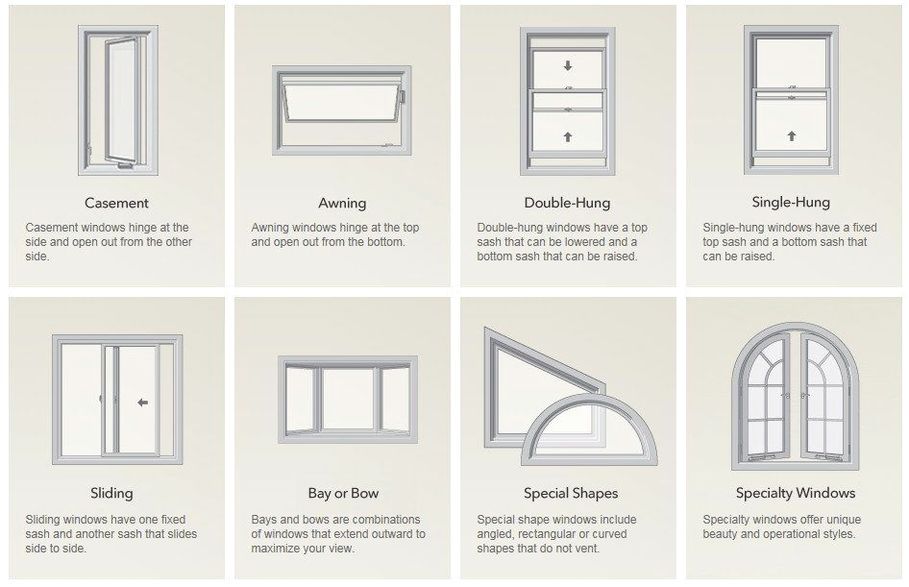
See the below image for the Different types of windows diagram. 18 Different Types of Home Windows – Styles and Pictures | Modernize. 1. Single Hung Windows. The major difference between a single hung window and a double hung window is how the different types of window sections move. 2. Double Hung Windows. 3. Arched Windows. 4. Awning Windows. 5. Bay Windows.

Each window type serves a different purpose and there are many different windows to choose from. Here you can find a list of 18 window styles, their average costs to install, pictures of each, and a little bit of information to help you decide which new home windows you would like to install in your home.

There are two forms of the sash window – the single-hung sash, and the double-hung sash The single-hung sash window usually has one part that is movable and the other one stationary. They open vertically, in a way that the lower sash moves up and down, while the upper sash remains fixed.

Different types of windows chart

Window structure diagram with labels

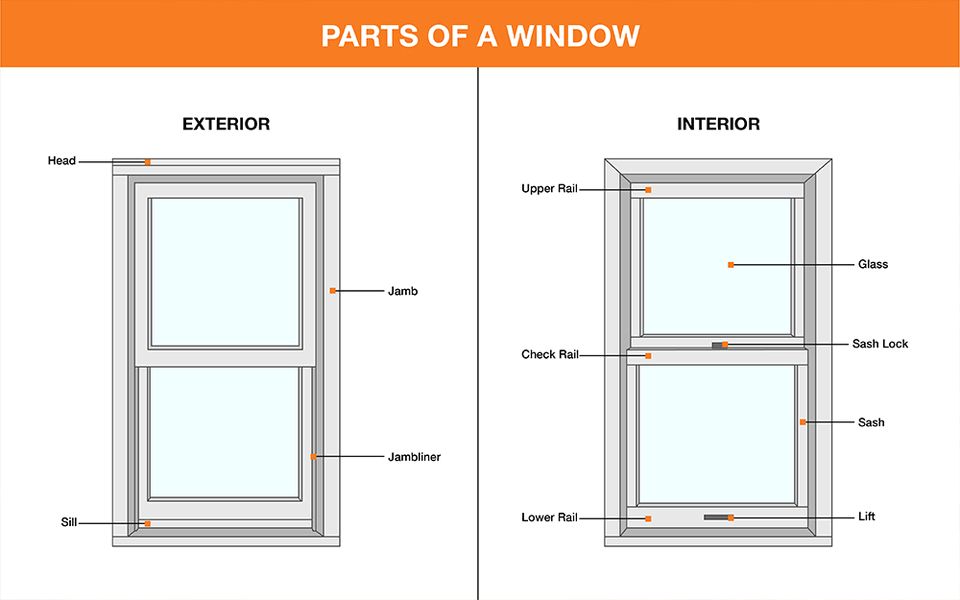
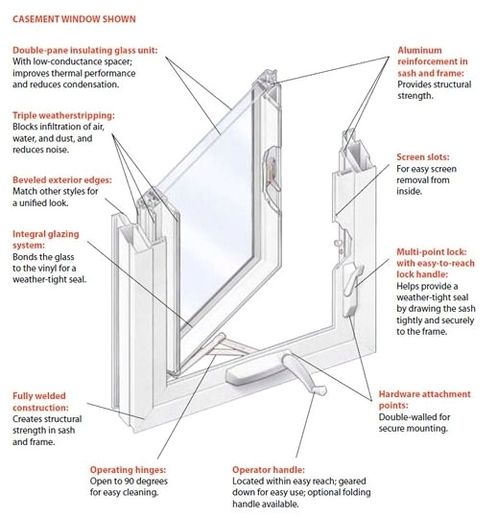
See the below image for the Window structure with labels diagram. Jambs are the main vertical parts forming the sides of a window frame. A sill is the main horizontal part forming the bottom of the frame of a window. A jambliner is a strip which goes on the sides of a window frame that provides a snug fit for the window sash. The interior of a window is the side homeowners will see most frequently.

The best way to compare windows and their labels is to visit one of our local showrooms in Maryland and Northern Virginia. We have a huge selection of windows on display from some of today’s best manufacturers, including Weather Shield and Infinity from Marvin.

To the right of the U-Factor on a window label is the Solar Heat Gain Coefficient (SHGC), which ranges from 0 to 1. This measures how well the window hinders radiant heat gain caused by exposure to direct sunlight.

Window structure diagram with labels