
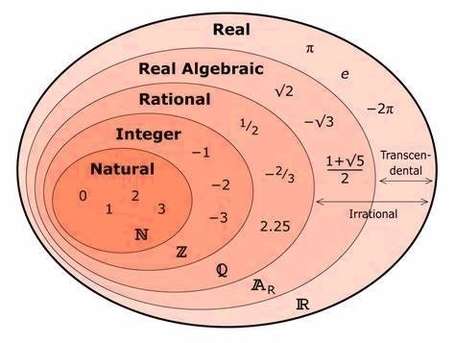
The set of real numbers is the most commonly used number system in mathematics and science. It includes all the numbers that can be represented by a decimal expansion, such as 3.14, -5, 0.333…, or ?2. The set of real numbers can be divided into two subsets: the rational numbers and the irrational numbers. The rational numbers are those that can be written as a ratio of two integers, such as 2/3, -4/5, or 7. The irrational numbers are those that cannot be written as a ratio of two integers, such as ?, e, or ?3. The irrational numbers have non-terminating and non-repeating decimal expansions.
The set of real numbers can be visualized by a number line, which is a horizontal line with a point labeled 0 at the center and equally spaced points to the left and right of 0. Each point on the number line corresponds to a real number, and the distance between any two points is the absolute value of their difference. For example, the distance between 2 and -3 on the number line is |2 – (-3)| = |2 + 3| = |5| = 5. The absolute value of a real number is always non-negative, and it measures how far the number is from 0. For example, the absolute value of -4 is |-4| = 4, which means that -4 is 4 units away from 0 on the number line.
The set of real numbers has many important properties and operations, such as addition, subtraction, multiplication, division, exponentiation, and order. These properties and operations obey certain rules, such as the commutative, associative, and distributive laws, which allow us to manipulate and simplify expressions involving real numbers. The set of real numbers also has special elements, such as 0, 1, and -1, which have unique roles in the operations. For example, 0 is the additive identity, which means that adding 0 to any real number does not change its value. Similarly, 1 is the multiplicative identity, which means that multiplying any real number by 1 does not change its value. And -1 is the additive inverse of 1, which means that adding -1 to 1 gives 0.
The set of real numbers is the foundation of many branches of mathematics, such as algebra, geometry, calculus, and analysis. It is also widely used in modeling and solving real-world problems, such as physics, engineering, economics, and statistics. The set of real numbers is not the only