
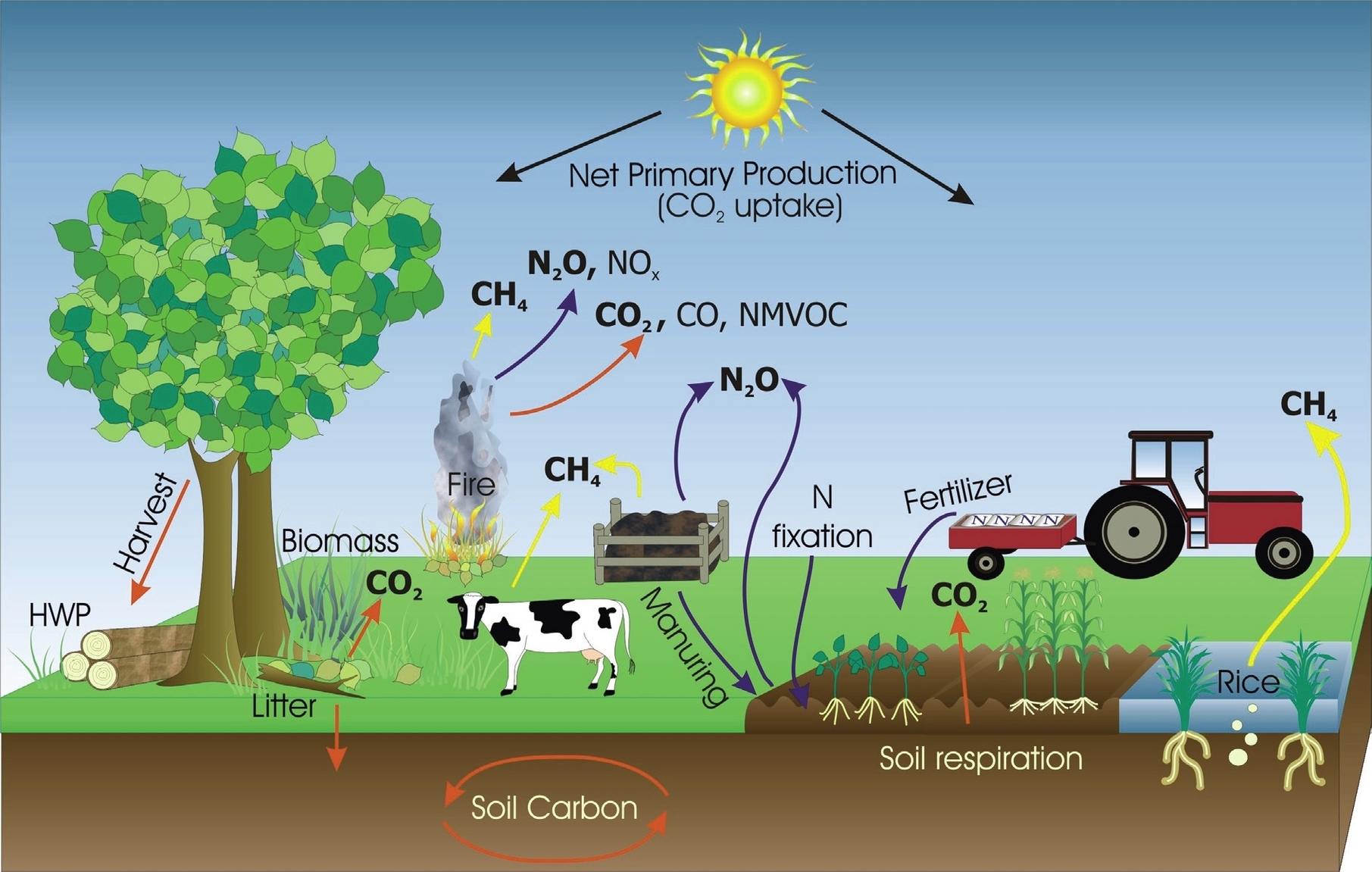
Greenhouse gas emissions from farming are the result of various agricultural activities that release carbon dioxide (CO2), methane (CH4), and nitrous oxide (N2O) into the atmosphere. These gases contribute to global warming and climate change by trapping heat and altering the Earth’s energy balance. Farming is both a source and a sink of greenhouse gases, meaning that it can either emit or absorb them depending on the practices and management of the land.
According to the Intergovernmental Panel on Climate Change (IPCC), agriculture accounted for about 10.6% of global anthropogenic greenhouse gas emissions in 2010. However, this estimate does not include emissions from land use change and forestry, which are often associated with agricultural expansion and intensification. If these emissions are included, the share of agriculture in global greenhouse gas emissions could be as high as 24%^2^.
The main sources of greenhouse gas emissions from farming are:
– Enteric fermentation: This is the process by which ruminant animals, such as cattle, sheep, and goats, digest plant material in their stomachs and produce methane as a by-product. Methane is a potent greenhouse gas, with a global warming potential (GWP) of 28 times that of CO2 over a 100-year period. Enteric fermentation is the largest source of methane emissions from agriculture, accounting for about 40% of total agricultural emissions in 2010.
– Manure management: This is the handling and storage of animal waste, which can also produce methane and nitrous oxide emissions. Methane is generated when manure decomposes anaerobically (without oxygen), such as in liquid or slurry systems. Nitrous oxide is emitted when manure is applied to soils or stored in aerobic (with oxygen) conditions, such as in solid or dry systems. Manure management contributed about 16% of total agricultural emissions in 2010.
– Synthetic fertilizers: These are chemical substances that provide nutrients, such as nitrogen and phosphorus, to crops and enhance their growth and yield. However, when applied in excess or under inappropriate conditions, synthetic fertilizers can also cause nitrous oxide emissions from soils. Nitrous oxide is a powerful greenhouse gas, with a GWP of 265 times that of CO2 over a 100-year period. Synthetic fertilizers were responsible for about 13% of total agricultural emissions in 2010.
– Rice cultivation: This is the production of rice, which is a staple food for more than half of the world’s population. Rice cultivation involves flooding the fields with water, creating anaerobic conditions that favor methane production